


Choosing the Right Unit Size
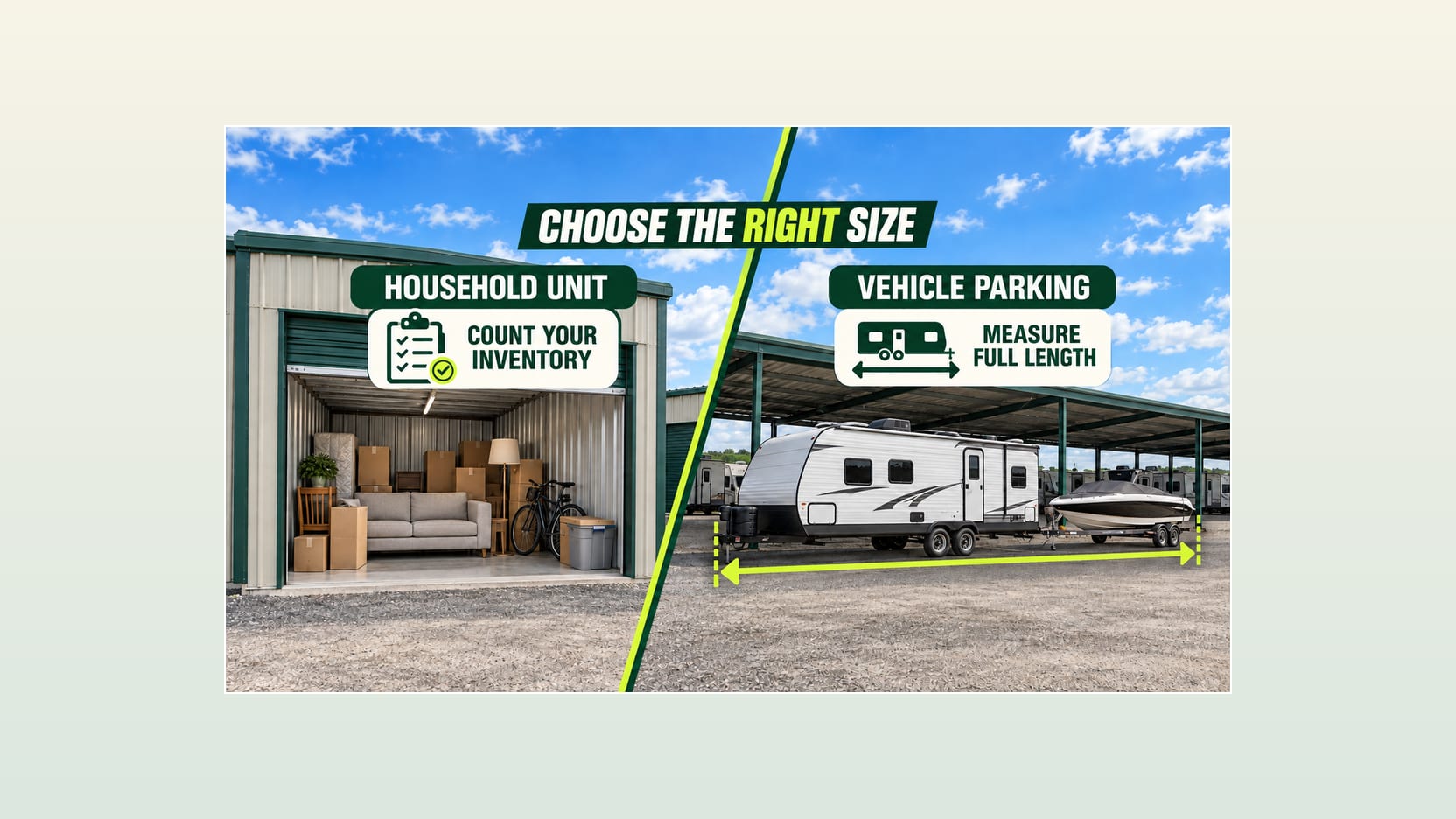
Most sizing guides treat this as one question. It is really two. If you are storing household items, the question is how much volume your things actually take up once they are boxed and stacked. If you are storing a boat, a trailer, or a work truck, the question is almost entirely about length, width, and how much room you need to maneuver in and out, and it has nothing to do with cubic feet. Renters who mix these two questions up are the ones who end up back at the counter a month later asking to switch spaces.
At a Glance
- Backyard Storage in Marion, TX offers non climate units in 10x10 and 10x15, climate controlled units in 10x10 and 10x15, and a larger 10x20 non climate unit.
- Parking spaces run from 12x16 open air up to a 12x60 stall, with covered spaces at 12.5x40 and 12.5x45 that include electricity.
- Household unit sizing should be based on an actual inventory count, not a rough guess at square footage.
- Vehicle and equipment parking sizing depends on the vehicle's real length and turning clearance, not the unit sizing chart most guides default to.
- A unit that is slightly too big is a minor overpayment. A unit that is slightly too small becomes a packing and access problem every time you visit it.
Sizing a Household Unit the Way You Actually Use It
Generic size charts tend to describe a unit by comparing it to a room in a house, a 10x10 holds a one bedroom apartment, a 10x20 holds a three bedroom house. That comparison is not wrong exactly, but it assumes your furniture packs as efficiently as a moving truck loaded by professionals, and most self packed units do not.
What Actually Eats Space in a Self Packed Unit
Boxes stack cleanly. Furniture does not. A sofa, a mattress set, and a dresser take up floor space you cannot reclaim by stacking anything on top of them without risking damage, and most renters leave a walking aisle down the middle of the unit so they can reach items in the back, which eats another 15 to 20 percent of the usable floor. A size chart built around theoretical cubic footage does not account for either of these, which is why a lot of renters end up a size larger than the chart told them to expect.
A Better Way to Estimate: Count, Do Not Guess
Before comparing sizes, walk through what you are actually storing and put it into three groups: furniture and large appliances, boxes, and irregular items like bikes, tools, or seasonal decorations. A one or two bedroom apartment worth of furniture plus a normal number of boxes generally lands in a 10x10 or 10x15 unit, depending on how much furniture is involved and whether you want walking room instead of a tight pack. A 10x20 makes more sense once you are storing the contents of a full house, a garage's worth of tools and equipment, or a combination of household goods and larger items you are not ready to part with during a move or renovation.
When Climate Control Changes the Size Decision
Climate control is usually framed as a separate decision from size, but the two interact. A climate controlled 10x10 costs you nothing in floor space compared to a non climate 10x10, but if you are debating between a smaller climate controlled unit and a larger non climate unit because you assume climate control is only available in smaller sizes, that assumption is worth checking against what is actually available before you decide. Backyard Storage carries climate controlled units in both 10x10 and 10x15, so the climate decision and the size decision do not have to fight each other the way they might elsewhere.
Sizing a Parking Space Is a Different Problem Entirely
This is the part most size guides skip, and it is the part that matters most for a lot of renters in this part of Guadalupe County. A boat, an RV, a trailer, or a work truck does not care about square footage. It cares about length, width, and whether there is enough room to pull in straight without a three point turn every time.
Measure the Vehicle, Not the Trailer Hitch
The number that matters is bumper to bumper, or bow to stern for a boat on a trailer, including anything that extends past the body, a ladder rack, a hitch mounted cargo carrier, a boat motor tilted up. People often measure the vehicle listing spec instead of the actual vehicle as loaded, and the two are not always the same number.
Matching Common Vehicles to Available Spaces
Backyard Storage offers open air parking from 12x16 up through a 12x60 stall, and covered parking with electricity at 12.5x40 and 12.5x45. A single axle boat and trailer combination or a mid size travel trailer often fits comfortably in one of the shorter open air spaces, while a larger fifth wheel, a full size RV, or a boat on a tandem axle trailer needs one of the longer stalls. If you plan to run a battery maintainer, block heater, or climate system on your RV or boat while it sits, the covered parking with electricity is worth considering specifically for that reason, not just for the roof over the vehicle.
Why Guessing Short Costs More Than Guessing Long
With a household unit, going one size smaller than you need means overpacking and losing access. With a parking space, going short means the vehicle genuinely may not fit, or fits with no room to walk around it for hookups, maintenance, or loading gear in and out. If you are between two sizes on a vehicle space, the safer call is the longer one, since there is no way to compress a trailer's actual length the way you can sometimes repack a box more efficiently.
A Simple Way to Decide Before You Rent
Write down what you are storing in one list. If everything on the list is furniture, boxes, or household goods, use the inventory count method above and compare against Backyard Storage's current unit and parking lineup to see exact dimensions side by side. If anything on the list has wheels or sits on a trailer, measure it directly, bumper to bumper, and treat that measurement as the deciding factor over any general size chart. Most renters who end up needing to switch sizes later are the ones who skipped one of these two steps and guessed instead.
If your list includes both, size the unit and the parking space separately using the two methods above rather than trying to find one space that solves both problems. A 10x15 unit for household goods and a 12x20 parking space for a boat are two different decisions, made with two different kinds of measurement, even though they might sit twenty feet apart on the same property.
Getting the Right Fit at Backyard Storage in Marion
Backyard Storage sits on FM78 East in Marion, and a lot of what we help renters figure out is exactly this kind of sizing question, especially for the boats and trailers that are so common around Canyon Lake and the rest of Guadalupe County. If you are not sure which size fits what you are storing, stop by or call and we will walk the property with you so you can see the actual dimensions in person before you commit to a space. For a closer look at how vehicle owners in this area think about parking specifically, our guide on RV and vehicle storage covers more of the day to day logistics beyond just fitting the vehicle in the space.