

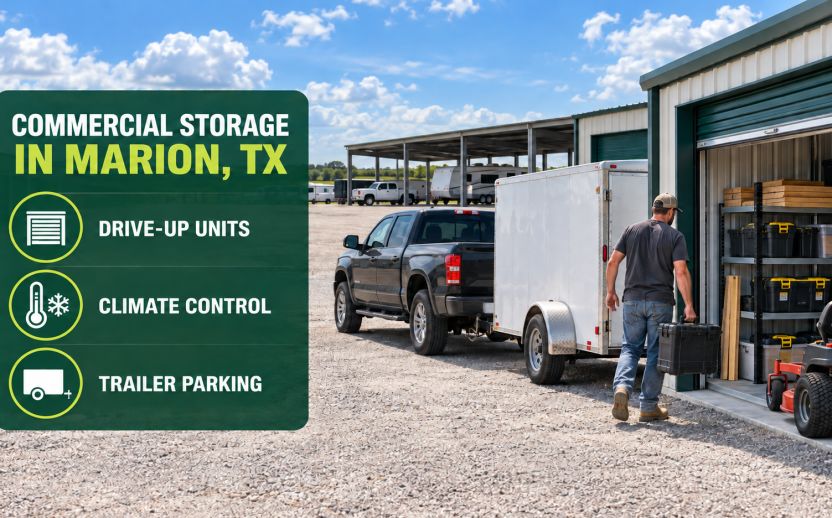
Most commercial storage pages talk about square footage and access hours. What a contractor actually needs to know is whether a facility understands that their business does not fit neatly into one unit type. A framing crew needs somewhere for lumber and tools. A landscaper needs somewhere for mowers, trailers, and fertilizer. An electrician needs a dry, temperature stable place for meters and finish materials that a hot metal box in July will not provide. Backyard Storage was not built as an afterthought commercial add on to a residential facility. It carries the range a real Guadalupe County operator actually needs, tools and inventory in a unit, vehicles and trailers in a parking space, on the same property.
At a Glance
- Backyard Storage in Marion, TX offers drive up units in 10x10, 10x15, and 10x20 for tools, inventory, and materials.
- Climate controlled units are available in 10x10 and 10x15 for equipment and materials sensitive to heat and humidity.
- Trailer and work truck parking runs from 12x16 open air spaces up to a 12x60 stall for larger equipment.
- Covered parking with electricity is available at 12.5x40 and 12.5x45 for vehicles or equipment that benefit from shore power.
- An on site propane fill station, air and water station, and dump station support contractors running equipment that needs regular servicing.
What Contractors Actually Need From a Storage Facility
A contractor's storage problem is rarely just about volume. It is about matching the right kind of space to the right kind of asset, and most facilities force that decision into a single unit type. A drive up unit alone does not solve where the trailer goes. A parking space alone does not solve where the hand tools and job site signage go. Backyard Storage solves both on one property, which matters more than it sounds like it should when you are trying to keep a crew's gear organized between jobs.
Different Trades Store Different Things
A framing or general construction crew is usually storing lumber, power tools, and scaffolding components, items that benefit from the wide, level access a drive up unit provides, since backing a truck straight up to the door beats carrying materials down a hallway. An electrician or HVAC technician is more likely storing finish materials, wiring, and battery powered tools that hold up better in a stable environment than a non climate box exposed to a full Texas summer. A landscaper is storing almost none of that. Mowers, trimmers, and trailers need parking and drive up access more than they need an enclosed unit at all.
Why Texas Heat Is a Real Cost Factor, Not a Sales Pitch
This is not a minor detail for anyone storing battery powered tools. The U.S. Department of Energy's Argonne National Laboratory has found that lithium ion batteries can lose up to 35 percent of their capacity in a year when stored at 104 degrees Fahrenheit, a temperature a closed metal unit in Marion regularly exceeds during summer months. That is a real, measurable cost for a contractor running cordless tools out of a non climate unit through July and August, not a marketing claim. It is one of the more practical reasons to weigh climate controlled storage for tool batteries, adhesives, and finish materials specifically, even if the rest of what a crew stores does not need it.
Pairing a Unit With Vehicle and Trailer Parking
The part most commercial storage pages skip entirely is that a contractor rarely needs only one type of space. A landscaping company might need a drive up unit for hand tools and a parking space for a trailer and a zero turn mower. A general contractor might need a unit for materials and a spot for a flatbed trailer between jobs. Backyard Storage's parking lineup runs from 12x16 open air spaces up through a 12x60 stall, which covers everything from a single axle utility trailer to a larger flatbed or equipment trailer, and the covered parking spaces at 12.5x40 and 12.5x45 come with electricity, useful for a work truck or trailer mounted equipment that benefits from a battery maintainer or block heater between uses.
Why Keeping Tools and Vehicles on One Property Matters
Splitting tool storage and vehicle parking across two locations costs a crew real time every morning and every evening, driving between a unit facility and a separate lot before ever reaching a job site. Keeping both on FM78 East means one stop to load a truck and hitch a trailer instead of two, which adds up over a season of daily site rotations more than it seems like it should on any single morning.
What This Is Not a Replacement For
Commercial storage at Backyard Storage is meant for tools, inventory, materials, and vehicle parking, not for operating a retail storefront or running deliveries and walk in customer traffic out of a unit. If your business needs regular customer access, loading dock service, or a permanent office presence, a commercial lease is still the right tool for that job. Where Backyard Storage earns its place is the space between a home garage that has run out of room and a full commercial lease that is more than a small operator actually needs, tool storage, materials, and a place to park equipment, without the overhead of a warehouse.
Storing Equipment That Needs Servicing
A detail worth mentioning for landscaping and lawn care operators specifically: Backyard Storage runs an on site propane fill station along with an air and water station and a dump station. If any of your equipment runs on propane or needs a regular tire check between jobs, that is one less stop on the way out in the morning.
Getting Set Up at Backyard Storage in Marion
Backyard Storage sits on FM78 East, a corridor a lot of contractors already run between Marion, Schertz, Cibolo, and Seguin, so a stop here rarely adds meaningful drive time to an existing route. If you are trying to figure out the right combination of unit and parking space for a specific trade, stop by or call and we can walk you through what actually fits your equipment rather than guessing from a size chart. For a closer look at how to think about sizing a unit or a parking space before you commit to one, our guide on choosing the right unit size covers the measurement approach in more detail. If your equipment trailer needs its own dedicated space rather than a shared lot, our trailer and equipment parking page covers hitching room, backing in versus pull through access, and matching trailer length to the right stall.